
LED Grow Light Fundamentals - Part 3
Understanding LED fixture specs (and how they affect your operation)
Horticulture lighting selection and deployment is one of the most consequential set of decisions indoor and greenhouse farm operators make, and product specifications play a key role in the decision-making process - but some are objectively more critical than others.

Dollar-per-kWh, environment, crop selection, yield targets, budget and numerous other factors play a role when deciding what fixture specifications are right for your operation. Knowing how and what specifications to prioritize for optimal business success can often be a daunting task without proper insight..
When evaluating horticulture lighting systems, you will often find yourself reviewing product spec sheets. Most of these documents look similar from product to product, highlighting key performance metrics, features and qualifications (see our LED Grow Lighting Glossary for an overview of the many items typically found on a grow light spec sheet).
In addition to the direct impact on plant growth and development through photosynthesis and other biological processes, fixture specifications also influence the requirements of key systems such as HVAC and electrical. While higher light intensity increases yields and lower power consumption reduces operating costs, properly evaluating and prioritizing product specifications to achieve these goals is essential to determining whether those benefits justify the capital investment and impact on ancillary systems.
All specifications have their place in the decision-making process, but some are objectively more critical than others – especially as they relate to your specific operation and goals.
Before going further, it’s important to clarify that fixture specifications must be evaluated in parallel with your lighting layout to ensure you are receiving the intended PPFD. Product specifications on their own are often meaningless if your lighting layout is not based on the necessary quantity of fixtures to deliver the light intensity required to achieve target yields. See our previous blog post on Verifying and Comparing Lighting Designs for more details.
From our perspective, the most important lighting specification to consider for any installation is wattage.
That said, individual fixture wattage is not particularly useful for comparing total wattage or total light output in a cultivation space, but it does play a role in light distribution and uniformity. Because of this, it can be tempting to compare fixture wattage directly, but that would be shortsighted.
Ultimately, total room wattage is what matters. It is the primary driver of sensible heat load in an indoor cultivation space. This, in turn, directly impacts total power consumption and associated costs including HVAC operating costs (OpEx) and capital costs (CapEx). Generally, fixtures should be spaced such that the distance between them is similar to the mounting height above the canopy to achieve optimal light uniformity. As such, the “ideal” fixture wattage will vary depending on uniformity targets, budget, available mounting height, and desired PPFD.
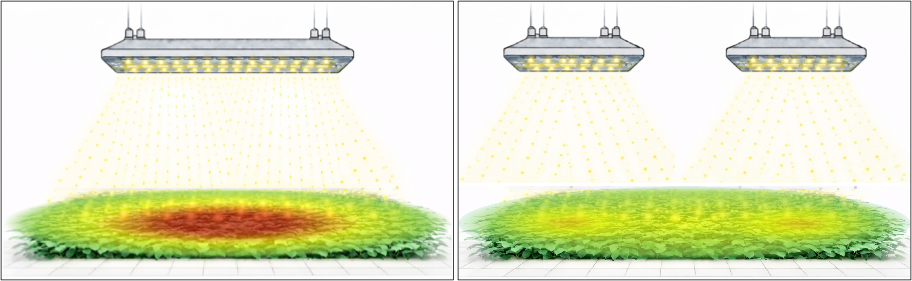
All-else being equal, two 400W fixtures will produce the same total light output and consume the same power as one 800W fixture. While specifications are identical, the resulting light distribution will often be drastically different.
Efficacy is another key metric when evaluating any lighting solution, as it defines how much light output (PPF) is generated per unit of power input (W). As discussed earlier, increasing wattage increases cost, while increasing PPF drives revenue through yield. Therefore, improving efficacy (getting more light per watt) can offer significant economic benefits.
As we’ll detail in a future article, increasing the number of LED chips on a fixture (which typically increases fixture cost) can improve efficacy. However, one of the most effective ways to increase efficacy is by shifting the spectrum toward higher red content, since red light is more energy-efficient to produce than other wavelengths. As discussed in our first LED Grow Light Fundaments overview, plants derive similar photosynthetic value from all photons within the PAR range, so increasing red content leverages this principle by delivering more photons per watt.
So why not use a 100% red spectrum?
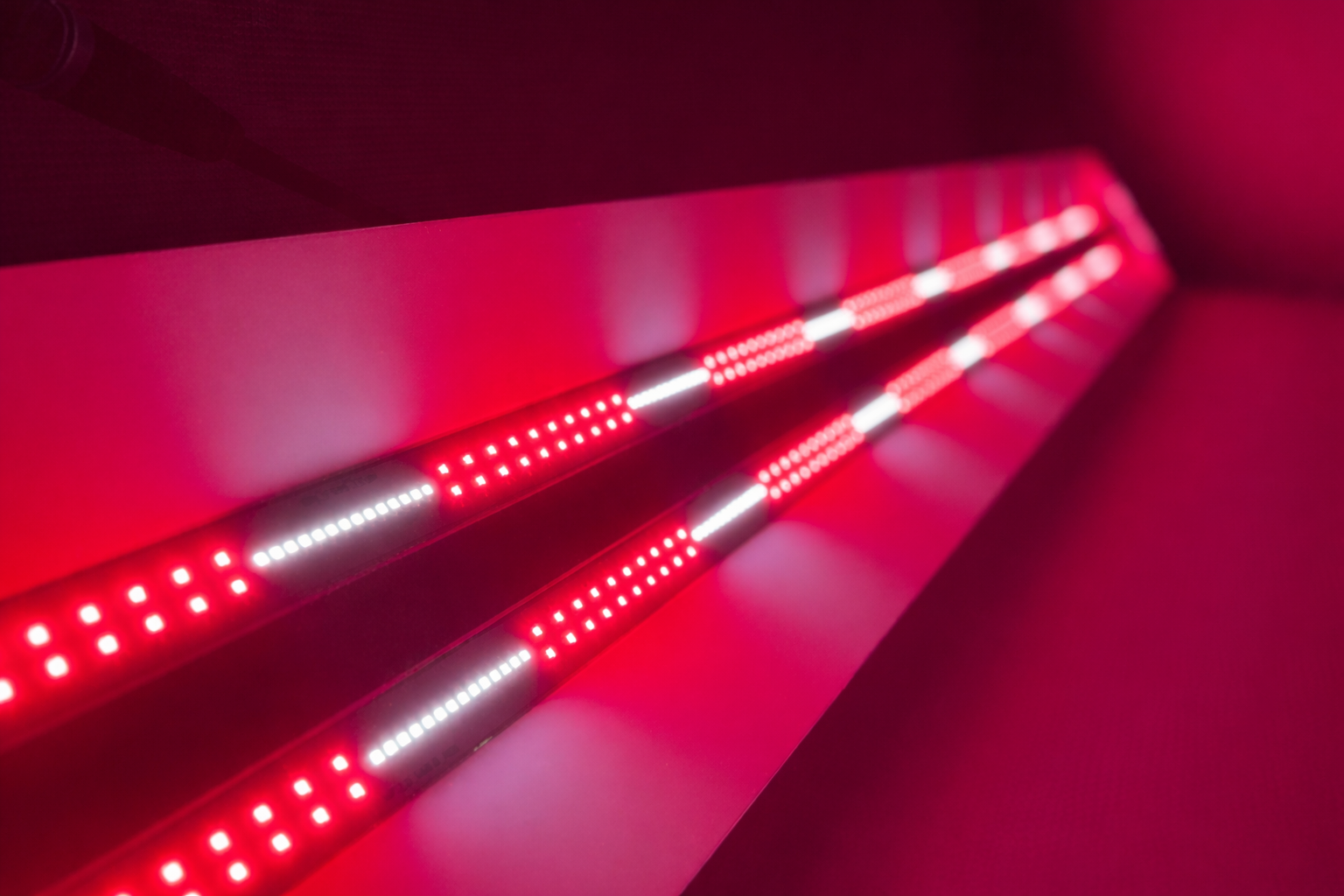
Spectrum is a critical spec (and highly subjective)
On paper, there are a lot of benefits to a spectrum with high red content; however, in practice those benefits may not be worth the tradeoff of a poor working environment and/or plant response.
High red content introduces its own set of challenges. From an operational standpoint, red-dominated light creates a poor visual environment, making it difficult to perform tasks such as plant work, deficiency identification, and IPM scouting.
From a plant physiology perspective, while chlorophyll readily absorbs red light, it can only process one photon at a time. In high red environments, photons can be absorbed faster than they are processed, leading to excess energy being dissipated as heat rather than used for photosynthesis. This can reduce efficiency, limit canopy penetration, and in extreme cases, contribute to photobleaching.
This leads into one of the most (if not the most) debated and discussed topics in horticulture lighting: spectrum. Rather than going too deep here, we’ll save a more detailed discussion of light quality (spectrum) for a future article. We will also cover the myriad of specifications not addressed here - not because they aren’t important, but because few have as significant an impact on performance as power and efficacy.
These two specifications affect cost and profit differently in every operation. Factors such as cultivar selection, price per pound (or kilogram), energy costs, labor, and environmental control capabilities all influence the value of each specification. There are many good lighting solutions available, but there is no single “best” fixture – only what is best for a given operation.
At Libra, our client-centric approach to developing customized lighting solutions, combined with a cost-plus pricing model, allows operators to select (and only pay for) the specifications that best support the financial performance of their business.
In our next article, we’ll take this one step further by evaluating grow lights not based on product specifications, but based on grow trials (and why those results are often misleading).